
0. The First Trick
Attention is All We Need

This post is free and open to everyone. It's the first in a series, and the rest will be for paid subscribers. If you find value here, subscribing is the best way to support this work. But I never want price to be the reason someone stops reading. If you can't afford it, just send me your email and I'll add you.
The Magician’s Kid
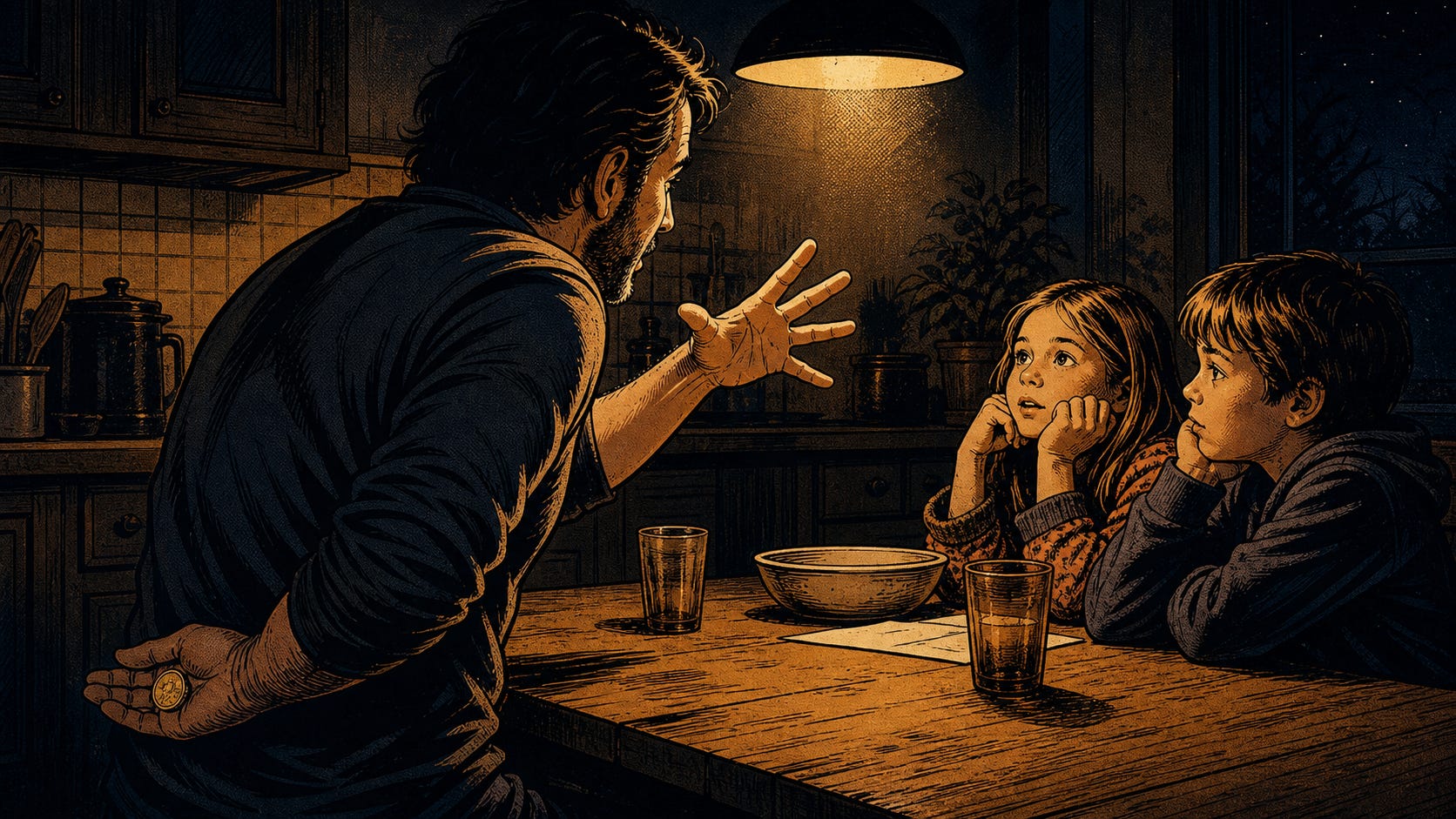
My dad did magic.
Not professionally. Not on stages or at corporate events. At birthday parties. At family gatherings. He was that dad. The one who could make a quarter disappear.
His signature move, at least the one I remember best, was the French Drop. If you’ve never heard the name, you’ve seen the trick. Everyone has. It’s the most fundamental sleight of hand in all of magic, and it goes like this:
He’d hold a coin in his left hand, pinched between his thumb and fingers, tilted so you could see it clearly. Then he’d reach over with his right hand, close his fingers around the coin, and pull his right hand away. He’d make a show of it. Squeeze the right fist. Blow on it. Open the fingers slowly. The coin was gone.
Then he’d reach behind your ear. Or your friend’s ear. And there it was. The whole table would erupt.
I must have watched him do this a hundred times.
Here’s the thing about the French Drop. The coin never moves. It never leaves the left hand. The “grab” with the right hand is the entire trick. Your eyes follow the hand that moves, because movement captures attention. The hand that stays still, the one quietly palming the coin against the fingers, goes unnoticed. The right hand is theater. The left hand is truth.
The trick isn’t in the hands. It’s in the attention.
If you want to try it yourself, or watch your kids try it, here’s a tutorial. It takes about five minutes to learn. It takes a lifetime to understand what it’s teaching you.
Because my dad didn’t just teach me a trick. He taught me a game. And the game was this: where is the magician trying to make you look? And what’s happening where he isn’t pointing?
I got hooked on that game. Not the magic itself. What fascinated me was the architecture underneath. The invisible structure of attention that made the trick possible. I learned to look not where people wanted me to look, but where I thought they didn’t want me to look. That instinct, that itch to find the left hand, shaped everything that came after.
I just didn’t have the vocabulary for it yet.
The Gentleman Thief
In 2013, a man named Apollo Robbins walked onto the TED stage and, over the course of eight minutes, stole everything that wasn’t bolted down.
Robbins is a pickpocket. The best in the world, by most accounts. His TED talk, “The Art of Misdirection,” has been viewed tens of millions of times, and it’s easy to see why. He pulls a volunteer from the audience and, while having a perfectly normal conversation about attention, removes the man’s watch. Then his wallet. Then the man’s glasses. The audience watches it happen in real time and still can’t quite see the move. It’s funny until you realize the implications.
What Robbins understands, at a level most neuroscientists are still trying to formalize, is that attention is a spotlight with a very narrow beam. You can only point it in one direction at a time. Everything outside the beam might as well not exist. A magician’s entire craft is built on this limitation. Control where the beam goes, and you control what the audience sees. Control what the audience sees, and you control what they believe.
He talks about the difference between what he calls the “frame” and the “moment.” The frame is the big picture, the overall narrative you’re following. The moment is the specific instant when the secret move happens. The art of misdirection is knowing when to shift someone between frame and moment, when to zoom them out so they miss the close-up, when to zoom them in so they miss the bigger pattern.
If that sounds like it might apply to more than card tricks, you’re already playing the game.
What’s remarkable about Robbins is that he didn’t stop at performance. He became a research collaborator. Working with neuroscientists at Johns Hopkins and UNLV, he helped design experiments that used magic techniques to study how attention actually works in the brain. The researchers discovered that Robbins was intuitively exploiting mechanisms they were only beginning to map: the attentional blink (the brief window after you notice something when you’re functionally blind to the next thing), the saccadic gap (the moment during an eye movement when visual processing goes dark), the hard limits of divided attention.
Magicians had been running experiments on attention for centuries. They just called them entertainment.
Watching Robbins, I recognized the game. The same one my dad played at the kitchen table, scaled up and turned into something that could fill a theater. The trick is always the same. Control where they look. The secret lives where they don’t.
But Robbins’ talk also planted a question I couldn’t shake. If one man on a stage can steal your watch while you’re staring right at him, what could an entire industry do with the same playbook and a multibillion-dollar budget?
What This Series Is About
Here’s the thesis, stated as plainly as I can.
Attention is the most fundamental resource you have. More fundamental than time, because time without attention is just a clock ticking. More fundamental than money, because money without attention is just numbers in an account. Without attention, you can’t perceive. You can’t decide. You can’t connect with another person. You can’t create anything worth creating. Attention is the prerequisite for everything that matters.
And we are living inside the most sophisticated misdirection act in human history.
Unlike my dad’s French Drop, nobody is showing us how this trick works. The platforms, the algorithms, the notification systems, the infinite scrolls, the variable reward loops, the entire machinery of what some people call the attention economy, all of it is designed to capture your spotlight and point it where someone else wants it to go. And it works. It works so well that most of us don’t even realize we’ve been looking at the right hand the whole time.
This series is going to take the trick apart.
We’re going to look at attention from four angles, four layers that build on each other the way a magician builds toward the big reveal.
The biology. What is actually happening in your brain when you pay attention? There’s a structure in your brainstem, smaller than a grain of rice, that acts as the master switch for everything you notice. We’ll start there. We’ll walk through how your brain decides what matters in a flood of information, how fast those decisions get made, and how much gets missed along the way.
The personal. What does attention feel like from the inside? And why does it feel so different for different people? If you’ve ever been told you have “too much” attention for some things and not enough for others, if a teacher or a boss or a well-meaning relative ever suggested that your brain was broken because it didn’t focus the way theirs did, there’s a reason for that. And it isn’t a deficit. It’s architecture.
The social. How did attention become a commodity? Who’s buying it, what are they doing with it, and what does it cost when the person you love is looking at their phone instead of at you? This is where the French Drop stops being a parlor trick and starts being a con. An entire economy built on the same principle my dad used at parties: make them look at the wrong hand. Except at industrial scale, and without the part where someone shows you how it’s done afterward.
The mechanical. What happened when engineers built attention into machines? In part by trying to copy the brain, but also by discovering the same underlying principle and engineering a completely different solution. In 2017, eight researchers published a paper called “Attention Is All You Need.” That paper, and the architecture it described, gave rise to every AI system making headlines today. What those machines learned about attention, what they missed, and what it means that they’re getting better at it faster than anyone expected.
And then, in the final essay, we come back to the magician. Because once you know how the trick works, every layer of it, you get to make the choice my dad gave me a long time ago. You get to decide where you actually want to look.
Each essay peels back another layer of the misdirection. The trick gets more sophisticated as we go. At the biological level, your own brain fools itself, filtering out more than it lets in. At the personal level, your particular wiring shapes what you see in ways you’ve probably never been told. At the social level, entire industries have been built on exploiting the same gap the French Drop exploits: the difference between where you’re looking and where you should be. At the mechanical level, we built machines that learned the trick too, and then reinvented it.
But the game is always the same. The one I learned at my dad’s table. Where are they pointing? And what’s happening where they aren’t?