
05. New World Experiments
Constructive Rebellion

American and Haitian Revolutions
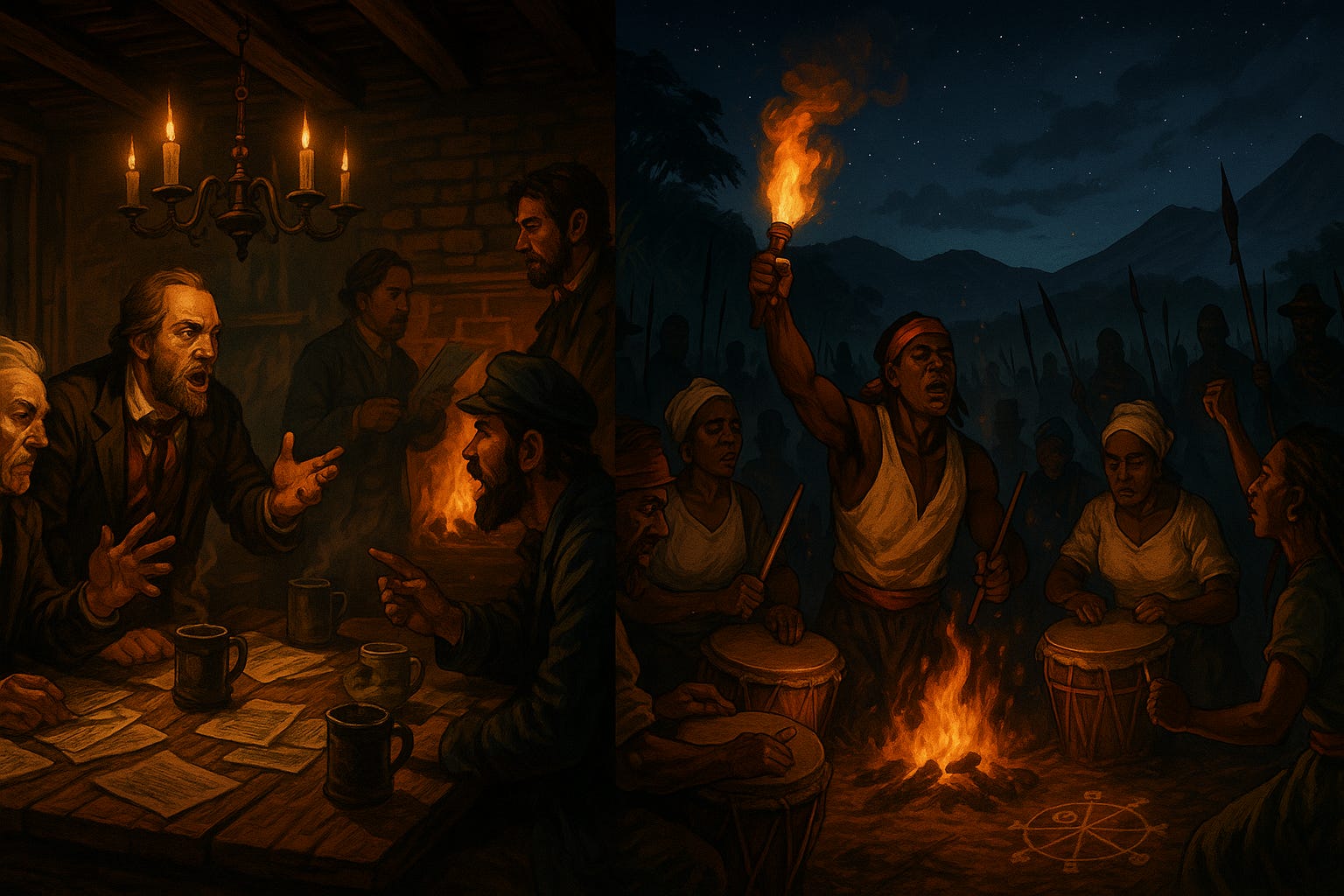
You sit in a coffeehouse in Philadelphia, December 1787. The air crackles with debate as news spreads of the Constitutional Convention's work. At the next table, a merchant argues passionately about federal power versus state sovereignty. Across the room, a printer discusses how quickly pamphlets can spread revolutionary ideas. Outside, the winter wind carries voices from the docks—sailors speaking of distant rebellions, of slaves in Saint-Domingue who have taken up arms not just for freedom, but for something unprecedented: a society where the color of one's skin determines nothing about one's rights.
Two experiments in human governance are unfolding simultaneously, each grappling with the same fundamental question that haunts us today: How do you design systems that serve human flourishing while preventing the concentration of power that corrupts?
The Atlantic world of the 1770s and 1780s was experiencing what we might recognize as a systems crisis. Old hierarchies—monarchy, aristocracy, slavery—suddenly seemed less natural, more constructed. Like us watching digital platforms reshape society, revolutionaries watched with growing clarity how political and economic systems could be designed rather than simply inherited.
The American Laboratory of Governance
The crisis began with what seems, in retrospect, almost quaint: a tax on tea. But you would have understood, standing in Boston Harbor in 1773, that this wasn't really about tea. The tea bobbing in the harbor represented something far more dangerous to established power—the principle that those who make rules affecting you should be accountable to you.
The British Parliament's response revealed the brittleness of systems that rely on force rather than consent. Each crackdown—the Intolerable Acts, the quartering of soldiers—demonstrated how quickly authority without legitimacy transforms into mere power. The colonists found themselves conducting a real-time experiment in what Hannah Arendt would later call "power versus violence": true power emerges from people acting together, while violence often signals the absence of such power.
The Continental Congress became an unlikely laboratory for distributed governance. Picture those delegates in 1774, representing thirteen distinct societies with different economies, religions, and legal traditions. They had no blueprint for coordinating resistance across such diversity. The Congress evolved organically—part committee, part parliament, part revolutionary council. Its authority came not from ancient tradition but from the novel principle that representatives derive power from ongoing consent.
When war came, the practical necessity of coordination drove constitutional innovation. The Articles of Confederation, often dismissed as too weak, represented a radical experiment: a voluntary association of sovereign states that somehow needed to function as a single entity for specific purposes. It failed in many ways—lacking power to tax, regulate commerce, or enforce decisions—but it succeeded in demonstrating both the possibility and the limitations of purely consensual governance.
The Constitutional Convention of 1787 began with a problem we recognize intimately: How do you distribute power in a system where different groups have conflicting interests? The Virginia Plan proposed representation by population, favoring large states. The New Jersey Plan demanded equal representation, protecting small states. For months, delegates wrestled with questions that echo in our debates about platform governance, corporate structure, and international institutions.
The breakthrough came through what Madison called "the compound republic"—federalism. Instead of centralizing all power or leaving everything to states, they created overlapping spheres of authority. States would handle local matters, the federal government would manage interstate and international concerns, and both would check the other's power. It was constitutional architecture designed for tension and compromise rather than efficiency or ideological purity.
The separation of powers added another layer of distributed authority. Legislative, executive, and judicial branches would compete for influence while checking each other's ambitions. Madison understood, as we're rediscovering with algorithmic systems, that you cannot simply trust good intentions or wise leadership. You need institutional structures that assume self-interest and design for accountability.
Perhaps most remarkably, they created the world's first written constitution as supreme law. Previous constitutions were collections of traditions, precedents, and customs—"unwritten" in the British sense. The American experiment made the fundamental rules explicit, amendable, and enforceable by courts. The document itself became a technology for limiting government power.
The Bill of Rights represented another innovation: explicit protections for individual and minority rights against majoritarian overreach. These weren't grants from government but recognition of pre-existing natural rights. Freedom of speech, press, religion, and assembly created protected spaces for dissent and diversity within the broader democratic framework.
Yet even as they crafted these innovations, the contradiction at the heart of American freedom festered like an untreated wound. How could a nation proclaiming that "all men are created equal" simultaneously hold half a million human beings in bondage?
The Haitian Revolution: Universal Emancipation
Nine hundred miles southeast of Philadelphia, another constitutional experiment was taking shape under vastly different circumstances. In the French colony of Saint-Domingue, enslaved Africans and their descendants made up over 80% of the population, laboring on sugar and coffee plantations that generated enormous wealth for their French masters.
You would have heard the drums at night if you lived there in August 1791. Not celebration, but coordination. Across the northern plains of the colony, enslaved people used traditional ceremonies to plan what would become the largest slave rebellion in history. But unlike previous uprisings focused on escape or revenge, this one would evolve into something unprecedented: a war for independence grounded in the principle of universal human freedom.
The rebellion's early leader, Toussaint L'Ouverture, understood something that many contemporaries missed: military victory without constitutional framework creates only temporary liberation. As he consolidated control over much of the colony, L'Ouverture began crafting institutions for a post-slavery society.
His 1801 Constitution for Saint-Domingue represented the most radical experiment in human equality the world had yet seen. Article 3 declared: "There cannot exist slaves on this territory, servitude is therein forever banished. All men are born, live and die free and French." But the constitution went further, prohibiting racial discrimination in any form and declaring that advancement in society would be based on merit alone.
L'Ouverture established a system of government that balanced executive power with legislative oversight, created an independent judiciary, and guaranteed religious freedom. He instituted public education and work requirements that applied equally to former masters and former slaves. The constitution even addressed what we might now call economic justice, regulating land ownership to prevent the re-emergence of plantation oligarchy.
The military effectiveness of the revolutionary army shattered European assumptions about racial hierarchy. Former slaves not only defeated local colonial forces but also armies sent by Napoleon—then at the height of his power. They combined guerrilla tactics learned in West African conflicts with European military technology and strategy. Their success demonstrated that oppressed people, given freedom and proper leadership, could match or exceed their oppressors in any field.
When Haiti declared independence in 1804, it became the first nation founded on the principle of universal human freedom regardless of race. The new constitution, crafted by L'Ouverture's successor Jean-Jacques Dessalines, went even further than its predecessor. It declared that all citizens, regardless of color, were to be known simply as "blacks," symbolically rejecting the racial hierarchies that had justified slavery.
The constitution also included what might be the most radical property clause in history: it welcomed any person of African descent from anywhere in the world to become a Haitian citizen and receive land. This wasn't just symbolic gesture but practical policy, offering an alternative model of citizenship based on shared struggle rather than bloodline or birthplace.
Parallel Innovations in Constitutional Design
Both revolutions faced the challenge of transforming military success into sustainable governance. Both discovered that destroying old systems was easier than building new ones. Both learned that constitutional frameworks must balance idealistic principles with practical necessities.
The Americans addressed the problem of faction through institutional design—separation of powers, federalism, judicial review. The Haitians addressed the problem of racial oppression through constitutional prohibition and cultural transformation. Both recognized that good intentions alone could not sustain revolutionary change; you needed institutional mechanisms that would outlast any particular generation of leaders.
Both constitutions established the radical principle that government authority derives from popular consent rather than traditional hierarchy. But they interpreted "popular" differently. The American Constitution initially limited voting to white male property owners, gradually expanding over centuries. The Haitian Constitution immediately included all adults regardless of race, gender, or previous condition of servitude.
The economic dimensions of both revolutions proved crucial to their political success. The American colonies had developed diverse economies that could function independently of British control. The Haitian rebels transformed the plantation economy not by abandoning agriculture but by redistributing land ownership and changing labor relations. Both understood that political freedom requires economic foundation.
Perhaps most importantly, both revolutions produced constitutional frameworks that proved more durable than their founding generations. The American Constitution, despite amendments and interpretation changes, remains the foundation of governance more than two centuries later. Haiti's constitutional tradition, despite subsequent political upheavals, established principles of racial equality and popular sovereignty that influenced liberation movements worldwide.
The Global Ripple Effect
The success of both revolutions sent shockwaves through the Atlantic world. European monarchies watched nervously as news spread of successful republican governments. Colonial subjects throughout the Americas began imagining their own independence. The Haitian Revolution particularly terrified slaveholding societies, leading to increased restrictions on free people of color and enslaved populations throughout the Caribbean and American South.
Simon Bolívar, the liberator of much of South America, explicitly credited both the American and Haitian examples for inspiring his revolutionary efforts. The Haitian government provided crucial military aid to Bolívar's campaigns, understanding that the survival of their own revolutionary experiment depended partly on the success of similar movements elsewhere.
But the revolutions also revealed the limits of constitutional innovation when confronted with entrenched interests. The American Constitution's compromises with slavery would eventually require a civil war to resolve. Haiti's radical egalitarianism led to international isolation, as European powers and the United States refused to recognize a government founded on racial equality.
The French imposed a crushing indemnity on Haiti in 1825, demanding payment for the "loss" of enslaved property—essentially requiring Haiti to purchase its own freedom. This debt, not fully paid until 1947, crippled Haiti's development and demonstrated how economic power could undermine constitutional innovations.
Lessons for Constitutional Design
These parallel experiments offer insights that resonate in our current moment of technological and political transformation. Both revolutions succeeded because they combined radical vision with practical institution-building. Neither fell into the trap of believing that good intentions alone could sustain social change.
The American emphasis on distributed power and checks and balances offers lessons for designing systems that can adapt and self-correct over time. The Haitian emphasis on universal equality and inclusion demonstrates how constitutional innovation can challenge fundamental assumptions about human hierarchy.
Both revolutions also illustrate the importance of economic foundation for political freedom. Constitutional rights remain fragile without the material basis for independence. This lesson seems particularly relevant as we grapple with how digital platforms and artificial intelligence might concentrate or distribute economic power.
Perhaps most crucially, both experiments show that constitutional design must account for ongoing tension and disagreement rather than seeking to eliminate conflict. The American system assumed that different groups would compete for power and designed institutions to channel that competition constructively. The Haitian system assumed that racial hierarchy would resist elimination and built in strong protections for equality.