
06. Modern Applications
Constructive Rebellion

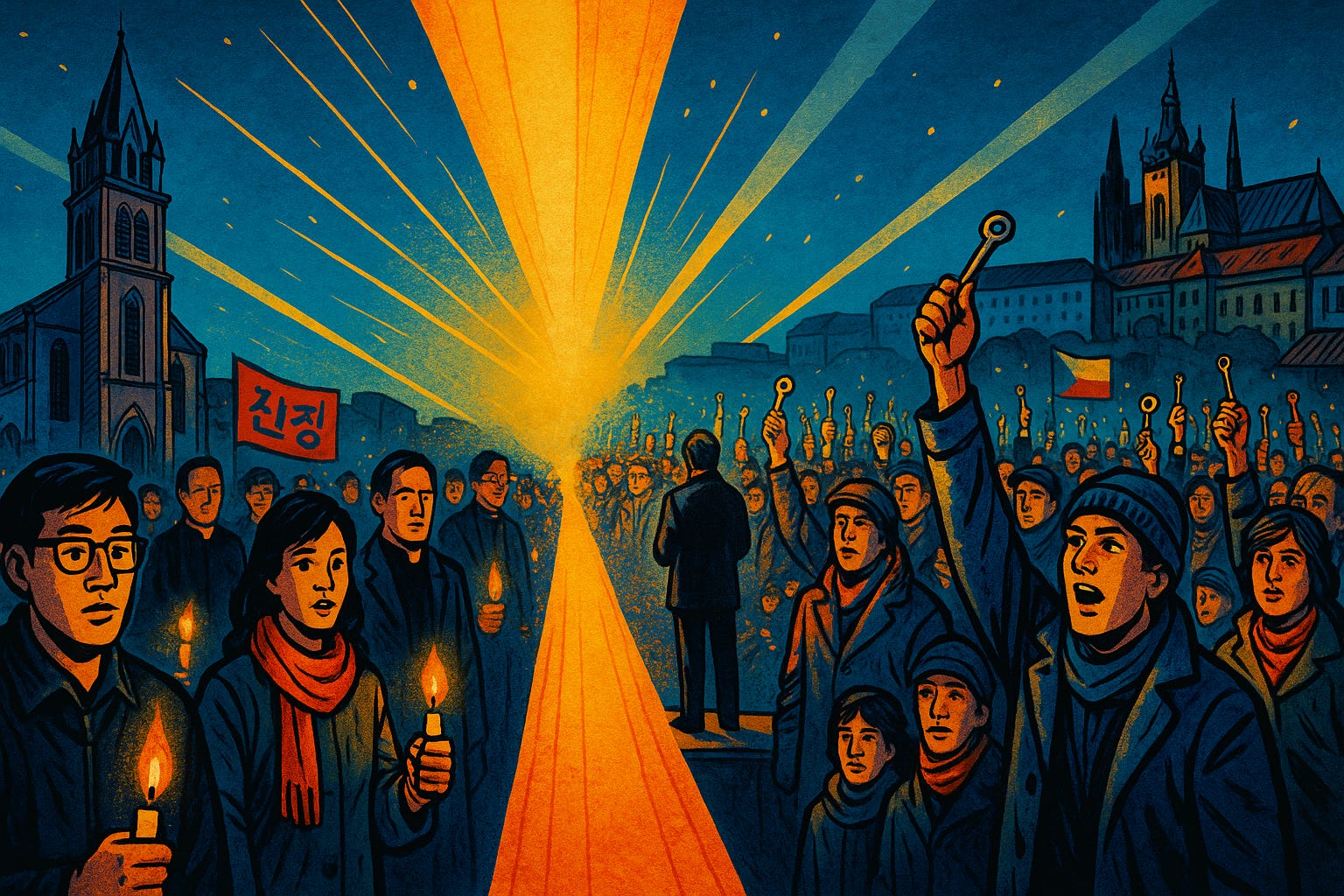
From Korea to Czechoslovakia
The Velvet Revolution and the Democracy Spring
You are standing in Seoul's Myeongdong Cathedral on June 10th, 1987, as tear gas drifts through the city streets outside. Inside, students and ordinary citizens huddle together, having sought sanctuary in this sacred space. The cathedral's bells ring out over a nation in transformation—not the violent overthrow that many expected, but something unprecedented: a million people demanding democracy through sheer moral force.
Half a world away, two years later, you might find yourself in Prague's Wenceslas Square on November 17th, 1989. A playwright named Václav Havel stands before hundreds of thousands of Czechoslovaks, his words carrying across cobblestones that have witnessed empires rise and fall. No shots are being fired. No barricades are burning. Instead, people jingle their keys—a gentle sound that will topple a communist regime more effectively than any army.
These are not the violent revolutions of earlier centuries. These are something entirely new in human history: mass movements that achieve fundamental political transformation through constructive rebellion—building new institutions even as they peacefully dismantle old ones.
The Korean Miracle's Democratic Turning
To understand what happened in Korea in 1987, you must first picture a country transformed beyond recognition in just two decades. The Korea of the 1960s was one of the world's poorest nations, devastated by war and ruled by military strongmen. But by the 1980s, something remarkable had occurred: a new middle class had emerged from the factories and universities, educated, prosperous, and increasingly unwilling to accept authoritarian rule.
General Chun Doo-hwan had seized power in 1980 through a military coup, establishing a regime that promised economic progress in exchange for political silence. For a time, this bargain held. Korea's GDP soared. Cities transformed. Universities expanded. But with each passing year, the very success of authoritarian development created the conditions for its own undoing.
By 1987, you could walk through Seoul's bustling commercial districts and witness the contradiction firsthand. Here was a society that had achieved first-world prosperity under third-world political institutions. Factory workers who had built the "Miracle on the Han River" increasingly asked why they could not vote for their leaders. University students who studied economics and philosophy wondered why their nation's political system lagged so far behind its economic achievements.
The spark came on January 14th, 1987, when a Seoul National University student named Park Jong-chul died under police torture. His death was not unique—authoritarian regimes routinely employed such methods. But something had changed in Korean society. Park's death became a symbol that united disparate groups: students, workers, middle-class professionals, and even business leaders who had previously supported military rule.
What followed was not the violent revolutionary model of earlier eras, but something that demonstrated how constructive rebellion had evolved. Instead of storming government buildings, protesters organized peaceful marches that filled city streets. Instead of violent confrontation with police, they employed what Gandhi had pioneered: non-violent resistance that exposed the regime's brutality to an increasingly horrified public.
The June Democracy Movement of 1987 saw over a million people take to the streets across Korea. But this was not mob rule—it was disciplined, organized civil society in action. Church groups provided sanctuary and coordination. Student organizations maintained non-violent discipline. Professional associations lent credibility and resources. Labor unions organized strikes that demonstrated the regime's dependence on popular cooperation.
Most remarkably, the movement created parallel institutions even as it challenged existing ones. Opposition leaders formed coordinated campaigns for constitutional reform. Civil society groups drafted alternative political frameworks. Citizens organized themselves into networks that could govern democratically—proving they were ready for democracy by practicing it in microcosm.
The regime's response revealed how completely the ground had shifted beneath authoritarian rule. When Chun Doo-hwan declared martial law and prepared to use force, his own military commanders began to question orders. Economic elites worried about international sanctions and domestic instability. Even within the ruling party, officials recognized that the old methods could no longer sustain legitimacy.
On June 29th, 1987, Roh Tae-woo—Chun's chosen successor—announced the "June 29 Declaration," accepting direct presidential elections and other democratic reforms. It was not a surrender to mob violence, but an acknowledgment that a society had fundamentally transformed. The constructive rebels had won not by destroying the state, but by demonstrating they could govern themselves.
Velvet Revolution in the Heart of Europe
If Korea's transition seemed unlikely, Czechoslovakia's appeared impossible. Here was a nation trapped at the heart of the Soviet empire, its 1968 Prague Spring crushed by Warsaw Pact tanks, its people living under one of Europe's most rigid communist regimes. Yet by November 1989, this same nation would achieve one of history's most elegant examples of constructive rebellion: the Velvet Revolution.
To understand how this happened, picture Czechoslovakia in the 1980s. Unlike Poland with its powerful Solidarity movement, or Hungary with its reformist communists, Czechs and Slovaks appeared politically quiescent. The regime of Gustáv Husák had achieved a kind of gray stability: economic stagnation in exchange for social peace, consumer goods in lieu of political rights.
But beneath this surface calm, civil society was quietly reorganizing itself. Charter 77, founded in 1977 by intellectuals including Václav Havel, had created networks of dissent that operated like underground streams—invisible to authorities but steadily eroding the foundations of communist rule. These were not violent conspirators but writers, philosophers, and ordinary citizens who insisted on simple principles: the government should obey its own laws, citizens should speak truthfully, and society should embrace fundamental human rights.
The genius of Charter 77 and similar movements lay in their constructive approach. Instead of plotting revolution, they practiced democracy. They held independent cultural events that demonstrated alternative forms of social organization. They distributed samizdat publications that kept democratic ideas alive. They created what Havel called "parallel polis"—alternative institutions that existed alongside official ones, gradually demonstrating the regime's irrelevance.
By November 1989, when university students organized a peaceful demonstration to commemorate International Students' Day, the ground was prepared for transformation. What began as a memorial march became something unprecedented: a mass awakening that would topple communist rule in just six weeks.
The revolution's velvet nature was no accident—it reflected decades of patient institution-building by civil society. When hundreds of thousands gathered in Wenceslas Square, they found ready-made leadership in Civic Forum, an umbrella organization that had emerged to coordinate opposition groups. When strikes spread across the country, workers discovered organizational models in independent labor movements that had operated underground for years.
Most remarkably, the revolution demonstrated how constructive rebellion could transform even former oppressors. Rather than violent retribution against communist officials, Civic Forum organized "round table" negotiations that peacefully transferred power. Rather than dismantling state institutions, democratic forces reformed them from within. The revolution's leaders, many of them formerly imprisoned dissidents, proved they could govern by governing—creating new democratic institutions while maintaining social stability.
The regime's collapse revealed how thoroughly civil society had undermined its foundations. When communist leaders called for counter-demonstrations, almost no one came. When they threatened force, their own security apparatus refused to act. The government that had once seemed omnipotent simply dissolved, leaving power to flow naturally to democratic alternatives that had spent years preparing to accept responsibility.
The New Grammar of Democratic Revolution
These modern examples reveal how fundamentally the nature of constructive rebellion had evolved by the late 20th century. In both Korea and Czechoslovakia, you can see patterns that distinguish contemporary democratic movements from their historical predecessors.
First, these were not peasant uprisings or elite coups, but middle-class movements led by educated urban populations. Economic development had created new social classes with both the resources and motivation to demand democratic participation. Factory workers who had achieved prosperity wanted political rights to match their economic status. University graduates refused to accept systems that treated them as subjects rather than citizens.
Second, both movements demonstrated the crucial role of civil society as an intermediary institution. Between individual citizens and the state, societies had developed dense networks of churches, professional associations, student organizations, and cultural groups. These provided the organizational infrastructure necessary for sustained democratic mobilization—what political scientists would later recognize as "social capital" essential for democratic governance.
Third, the international context enabled peaceful transitions in ways that would have been impossible in earlier eras. The Korean government faced pressure from the United States, its key strategic ally, to democratize. The Czechoslovak regime confronted Mikhail Gorbachev's Soviet Union, which had explicitly abandoned the Brezhnev Doctrine of intervention to preserve communist rule. Both movements operated within international systems that favored democratic legitimacy.
Fourth, technology played an unprecedented role in organizing resistance and documenting regime brutality. Korean protesters used emerging communications technologies to coordinate massive demonstrations. Czechoslovak dissidents employed photocopying and audio recording to spread democratic ideas. While primitive by today's standards, these technologies enabled civil society to organize more effectively than ever before.
But perhaps most significantly, both movements demonstrated how constructive rebellion had evolved beyond negative resistance to positive institution-building. Korean democrats didn't merely oppose military rule—they created alternative political organizations capable of governing democratically. Czechoslovak dissidents didn't simply criticize communist ideology—they developed practical models of civil society, market economics, and democratic governance.
This positive vision explains why both transitions succeeded where many revolutionary movements fail. Rather than creating power vacuums that invite chaos or new forms of authoritarianism, constructive rebels in Korea and Czechoslovakia demonstrated they were ready for responsibility by exercising it during the transition itself.
Patterns for a New Century
As you reflect on these remarkable transformations, certain patterns emerge that illuminate the evolution of constructive rebellion in the modern era. Both Korea and Czechoslovakia achieved what had seemed impossible: fundamental political change without devastating social disruption, democratic transition without revolutionary violence, transformation that built rather than destroyed institutional capacity.
These successes required specific conditions that help us understand when constructive rebellion becomes possible. Economic development that creates educated middle classes. Civil society organizations that provide democratic training grounds. International environments that support rather than suppress democratic movements. Technologies that enable citizen coordination while documenting government abuse.
But they also required something more intangible: what we might call democratic culture—shared beliefs that political problems can be solved through peaceful negotiation rather than violent domination, that power should flow from citizen consent rather than elite coercion, that societal conflicts can be managed through institutional channels rather than revolutionary upheaval.
The Korean Democracy Movement and Velvet Revolution thus represent not just successful political transitions, but successful examples of constructive rebellion adapted to modern conditions. They show how the ancient wisdom of building while resisting, of creating alternatives while challenging existing systems, can work even under contemporary authoritarian regimes.
Their legacy extends far beyond their own societies. From the Philippines' People Power Revolution to Eastern Europe's peaceful transitions to the Arab Spring's early promise, movements worldwide have studied and adapted the methods pioneered in Seoul and Prague. The grammar of democratic revolution they developed—non-violent mass mobilization, civil society leadership, international support, technological coordination—has become the standard playbook for democratic movements worldwide.
Yet these cases also reveal the limitations and challenges that modern constructive rebellion faces. Both Korea and Czechoslovakia enjoyed relatively favorable conditions for peaceful transition. Not all authoritarian regimes face similar international pressure to democratize. Not all societies possess the civil society infrastructure necessary for sustained non-violent resistance. Not all movements can maintain the disciplined non-violence that makes constructive rebellion possible.
As we move deeper into the 21st century, the examples of Korea and Czechoslovakia remain both inspirational and instructional. They demonstrate that even the most entrenched authoritarian systems can be transformed through patient, organized, constructive resistance. They show how ordinary citizens, when properly organized and motivated, can achieve extraordinary political transformation without resorting to the destructive methods that have characterized so many revolutionary movements throughout history.
But they also remind us that constructive rebellion remains an art as much as a science—requiring careful attention to specific contexts, skillful leadership, sustained commitment, and often considerable luck. The velvet revolutions of the late 20th century created new possibilities for democratic change, but realizing those possibilities in each new context requires fresh creativity and adaptation.
The students filling Seoul's Myeongdong Cathedral and the citizens jingling keys in Prague's Wenceslas Square offer us more than historical inspiration. They provide practical models for how societies can transform themselves peacefully, how citizens can claim democratic rights without destroying social fabric, how constructive rebellion can build the future even as it challenges the present.
In our own era of global democratic challenges, their example remains vitally relevant. They remind us that fundamental political change is possible, that peaceful transformation can succeed where violent revolution fails, that ordinary citizens possess extraordinary power when they choose to exercise it constructively rather than destructively.
Their legacy lives on in every peaceful protest that builds rather than burns, in every civil society organization that demonstrates democratic values in practice, in every movement that chooses the harder path of construction over the easier path of destruction. They show us that the future belongs not to those who can destroy most effectively, but to those who can build most wisely—one citizen, one institution, one peaceful transformation at a time.
What transformation are you building in your own corner of the world? What institutions are you creating to embody the values you seek? How will you choose construction over destruction when faced with systems that demand change?
The bells of Myeongdong and the keys of Wenceslas Square still echo through our contemporary world, calling us to our own forms of constructive rebellion, our own peaceful revolutions, our own patient work of building democracy where authoritarianism once stood unchallenged.