
2. The Nuclear Option
You Fascist Nazi!

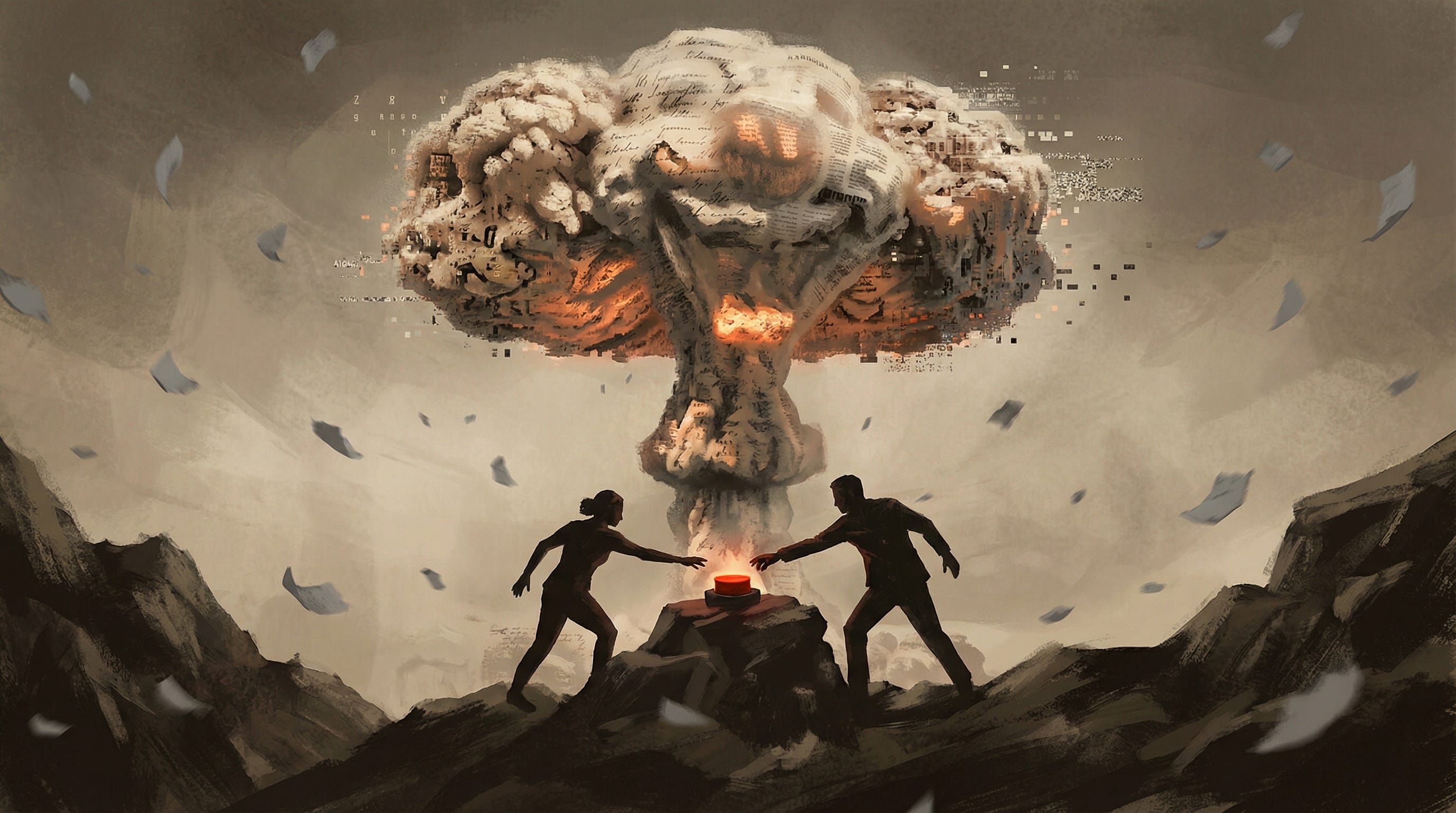
You’ve seen this. You’ve probably done this.
If you lean left, think back to the last few years. You’ve probably called someone a fascist. Maybe Trump. Maybe a local politician pushing voter ID laws. Maybe your uncle at Thanksgiving, the one who watches too much cable news and won’t stop talking about the border.
You’ve probably compared something to Nazi Germany. The detention centers. The book bans. The attacks on the press. Maybe January 6th. The comparison felt apt. It felt urgent. It felt like the only way to convey the stakes.
If you lean right, you’ve done it too.
Vaccine mandates were “just like what the Nazis did.” Gun control advocates want to disarm you “like Hitler disarmed the Jews.” Cancel culture is “digital fascism.” The social credit scores. The surveillance state. The way Big Tech silences dissent. Antifa, somehow, are the real fascists. The comparison felt apt. It felt urgent. It felt like the only way to convey the stakes.
Here’s what I want you to notice: both of you are right that something feels wrong. Both of you sense that something important is at stake. And both of you reached for the same weapon.
The nuclear option.
The strongest word we have.
What Happens When Everyone Goes Nuclear
There’s a term in psychology called semantic satiation. It describes what happens when you repeat a word over and over until it loses all meaning. Say “bowl” fifty times in a row. By the end, it’s just a sound. The connection between the word and the thing it represents has temporarily broken.
Leon Jakobovits James coined the term in 1962 while studying how repetition affects cognition. He found that when a word is repeated, the neural pathways that connect sound to meaning get fatigued. The brain stops processing it as language and starts hearing it as noise.
Now scale that up to an entire culture.
When “fascist” gets applied to everything, from immigration enforcement to vaccine requirements to drag queen story hours to parental rights legislation, the word stops triggering any particular response.
You’re not warning anyone anymore. You’re just making a sound.
And when everyone uses nuclear weapons, eventually the landscape is just ash. The words lose their charge. The warnings lose their power. And we’re left standing in the fallout, wondering why no one listens anymore.
The Timeline You Already Know
This isn’t new. That’s the depressing part.
Reagan was called a fascist. His opponents compared him to Hitler. One Los Angeles Times cartoonist literally depicted him plotting a putsch in a Munich beer hall. Representative William Clay accused him of “trying to replace the Bill of Rights with fascist precepts lifted verbatim from Mein Kampf.”
Bush got compared to Hitler so often that MoveOn.org had to pull a contest after receiving 1,500 such entries. Actress Janeane Garofalo called his administration “the 43rd Reich.” Another celebrity, David Clennant, helpfully clarified that he wasn’t comparing Bush to Hitler, because “George Bush is not as smart as Adolf Hitler.”
Every Republican president since Goldwater has faced extensive Nazi comparisons. Every single one. For sixty years.
Meanwhile, the other side has been doing the same thing.
Communists in the 1930s called moderate Social Democrats “social fascists.” The Berlin Wall was officially named the “Anti-Fascist Protection Rampart.” Today, progressives get called fascist for supporting hate speech laws. Antifa, whose name literally means anti-fascist, gets called fascist with a straight face.
The word has been applied to both sides of literally every political divide. Pro-choice and pro-life. Pro-gun and anti-gun. Pro-immigration and anti-immigration. Climate activists and climate skeptics.
If everyone is a fascist, no one is.
The Research on Desensitization
Studies on exposure to hate speech found something troubling: repetition leads to desensitization. The more you hear extreme language, the less it registers. Research in Poland found that “frequent and repetitive exposure to hate speech leads to desensitization” and “lower evaluations of victims.”
In other words, the more we call everything Nazi-level bad, the less we care when something actually approaches that threshold.
Research on elite rhetoric found similar effects. When political leaders repeatedly violate norms, when they use extreme language casually, it “erodes trust and confidence” and increases “beliefs that elections are rigged.” The transgression becomes the new normal. The alarm bells stop ringing because the bells have been ringing constantly.
The U.S. Holocaust Memorial Museum tried to warn about this. Their historian Edna Friedberg wrote that careless Holocaust analogies “distract from the real issues challenging our society” and “shut down productive, thoughtful discourse.”
More pointedly: “When we reduce the Holocaust to a flattened morality tale, we forfeit the chance to learn from its horrific specificity.”
We don’t learn from history when history becomes a rhetorical weapon. We just lose the ability to recognize what history was warning us about.
The Appeal of the Nuclear Option
I want to be fair here. I understand why people reach for these comparisons.
When something feels genuinely threatening, when you believe rights are being stripped away or institutions are being corrupted, ordinary language feels inadequate. Saying “I disagree with this policy” doesn’t capture the stakes. Saying “this concerns me” sounds weak. You want language that matches the urgency you feel.
And what’s more urgent than invoking the worst thing that ever happened?
The nuclear option feels righteous. It feels proportionate. It feels like you’re taking the threat seriously, unlike all those complacent people who don’t see what you see.
Plus, it works. In the short term. It gets attention. It rallies your side. It signals that you’re one of the people who understands how bad things really are.
The problem is that it works like a drug. You build tolerance. You need higher doses to get the same effect. And eventually, you’ve depleted the stockpile entirely.
What You Actually Sound Like
Let me try something uncomfortable.
Imagine you’re on the other side of one of these comparisons. Someone you disagree with politically just called something you support “fascist” or “Nazi-like.”
How does that feel?
Does it make you reconsider your position? Does it open you to dialogue? Does it make you think “hmm, maybe I should examine my beliefs”?
Or does it make you dismiss the speaker as hysterical? Does it confirm your suspicion that the other side has lost all perspective? Does it make you less likely to take their concerns seriously in the future?
I’m guessing it’s the second one. Because that’s how it works for everyone.
The nuclear option doesn’t persuade. It doesn’t open minds. It doesn’t build coalitions. It does exactly one thing: it signals tribal membership. It tells your in-group that you’re one of them and tells the out-group that they’re irredeemably evil.
And it burns the words as it uses them.
Truth to Power
Here’s what I keep coming back to.
Using “Nazi” or “fascist” feels powerful. It feels like you’re pulling out the big guns. It feels like the rhetorical equivalent of a decisive strike.
But what if you’ve been pulling them out so often that they’re empty now?
What if, when something genuinely approaches that threshold, when the warning would actually be warranted, no one hears it?
Not because they’re complacent. Not because they don’t care. But because they’ve heard it so many times, applied to so many things, that the word has become noise.
The boy who cried wolf didn’t lose credibility because wolves weren’t real. He lost credibility because he kept crying wolf when there wasn’t one.
We’ve been crying wolf for sixty years. From all sides. About everything.
And now?
Now we’re not sure what to call the wolves.