
3. The Three-Generation Countdown
You Facist Nazi

Let me ask you something.
When’s the last time you thought about World War II? Not as a reference point. Not as a comparison. Not as ammunition in an argument about whether some politician is “basically Hitler.”
I mean as a thing that actually happened. To actual people. Many of whom are still alive.
When’s the last time you encountered a survivor? Heard their voice? Saw their face?
I’m guessing it’s been a while. Maybe never.
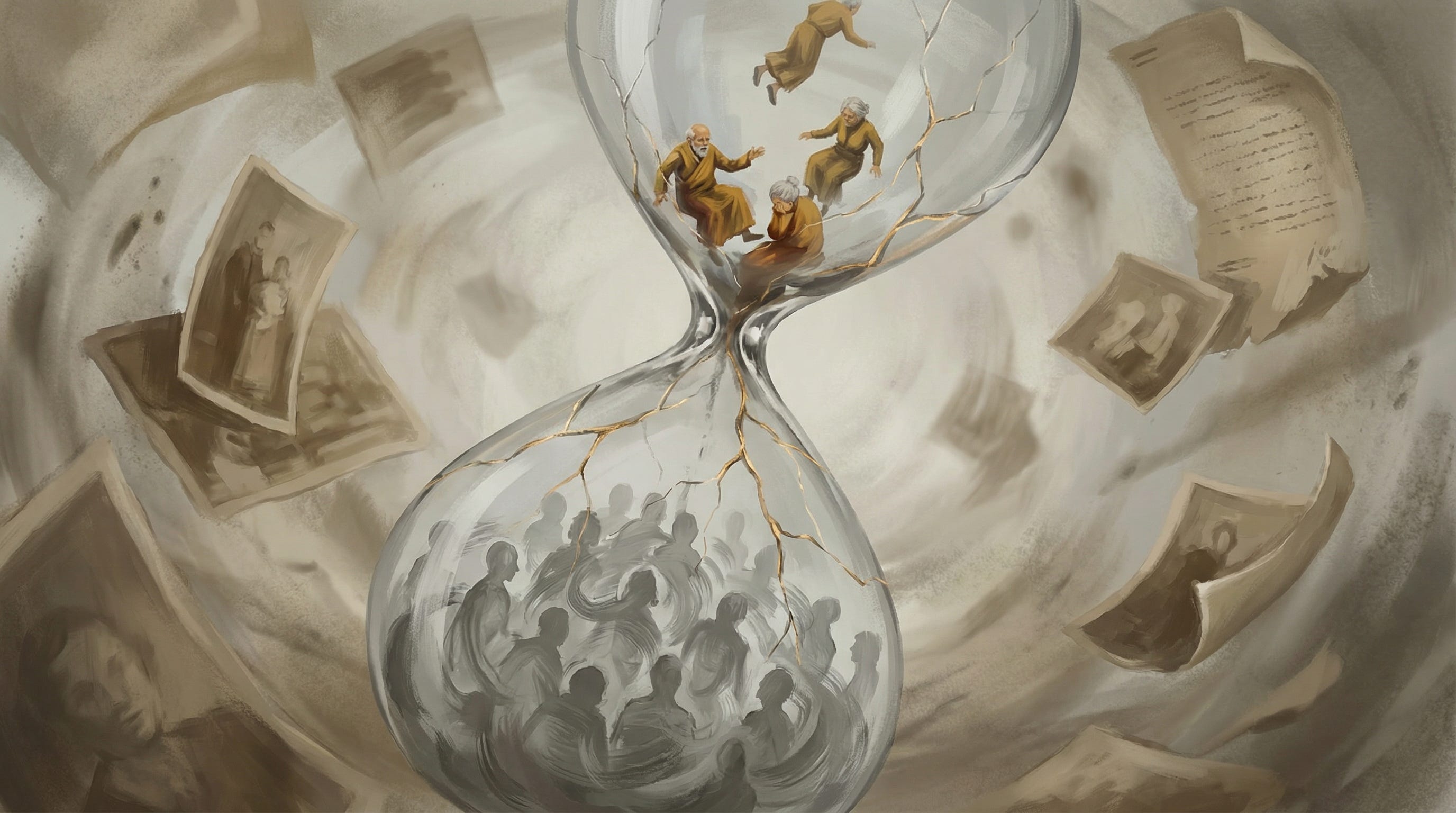
Here’s the math that keeps me up at night. World War II ended in 1945. That’s 80 years ago. The youngest survivors who remember anything meaningful would have been maybe five or six at the end of the war. They’re in their late 80s now. In ten years, maybe fifteen, there will be almost no one left who can say “I was there.”
The living memory is dying. And we’re not ready.
The Science of Forgetting
There’s research on how collective memory works. It’s not comforting.
Psychologists talk about something called the “critical period.” What happens during your formative years, roughly ages 15 to 25, sticks with you in a way that events before or after don’t. You remember what was happening in the world when you were coming of age. It becomes part of your identity, not just your knowledge.
This creates a predictable pattern for how societies remember.
For the first generation, the witnesses, memory is episodic. Sensory. Emotional. You can still hear the sound. You can still smell the smoke. The memory isn’t something you learned. It’s something that happened to your body.
For the second generation, the children of witnesses, memory becomes what scholar Marianne Hirsch calls “postmemory.” You didn’t experience it directly, but you lived in its shadow. Your parents’ trauma shaped your childhood. Research shows that children of Holocaust survivors have higher rates of PTSD and nightmares about events they never witnessed. The trauma passes down. Not the memory itself, but the weight of it.
For the third generation, the grandchildren, it becomes identity rather than memory. “My grandmother survived.” A fact about yourself. Something that makes you who you are. But not a felt reality. Not something you carry in your nervous system.
For the fourth generation? It’s taught history. Completely dependent on institutions. On curriculum. On whether anyone bothered to build a museum. On whether anyone is still telling the story.
Three generations. That’s the half-life. After that, it’s just books and documentaries.
The Numbers
A 2018 survey found that 66% of American millennials, my generation, couldn’t identify what Auschwitz was. Not a trick question. Not asking for details about the gas chambers or the death toll. Just: what is this place?
Two-thirds didn’t know.
22% said they hadn’t heard of the Holocaust. At all.
Another study found that two-thirds of millennials don’t know who won World War II. 40% were unaware of the Dunkirk evacuation.
This isn’t about intelligence. It’s not about millennials being uniquely ignorant. It’s about what happens when living memory fades and institutional memory fails to pick up the slack.
The witnesses are dying. The postmemory generation is aging. And we’re entering the phase where the only thing standing between us and forgetting is how well we’ve built the infrastructure of remembrance.
Spoiler: we haven’t built it well.
The Availability Heuristic
Here’s the psychological trap we’re walking into.
Our brains judge probability by how easily we can imagine something. This is called the availability heuristic. What comes to mind easily feels possible. What feels distant feels impossible.
When your grandmother tells you about the war, when you can see the number tattooed on her arm, when you hear her voice crack telling a story she never finished, the Holocaust feels possible. It happened. It could happen again. The evidence is sitting at your dinner table.
When it’s just a chapter in a textbook? When the only images are black-and-white photographs of people who look nothing like anyone you know? When there’s no living voice to make it real?
“It can’t happen here” becomes the default. Not because you’ve thought it through. Not because you’ve analyzed the conditions that made it possible and concluded they don’t apply. But because you can’t picture it. It doesn’t feel real.
The availability heuristic is a feature, not a bug. It usually serves us well. But it fails catastrophically when the thing we need to remember is deliberately moving out of living memory.
Germany’s Unlikely Success
By all rights, Germany should have failed at this. Denazification after the war was, according to historians, “a consummate failure.” By 1951, 94% of judges and prosecutors in Bavaria were former Nazis. Not because Bavaria was uniquely bad. Because the country needed administrators, and all the experienced administrators had been party members. Cold War priorities took over. Everyone needed Germany functional and anti-Soviet. Nobody wanted to look too closely at who was running things.
The trials at Nuremberg prosecuted the top leadership. But the vast middle layer of perpetrators? The bureaucrats who processed the deportations? The train conductors who drove the cattle cars? The neighbors who moved into Jewish homes? Most of them faced no consequences. Many of them thrived.
And yet.
Somehow, Germany became the one country that actually maintained historical consciousness across generations. How?
It wasn’t automatic. It took decades. And it required deliberate, sustained institutional commitment.
Constitutional patriotism
Rather than grounding national identity in blood and soil, post-war Germany (with a lot of help from philosophers like Jürgen Habermas) developed a concept called Verfassungspatriotismus. Political belonging centered on democratic principles rather than ethnic identity. You’re German because you commit to the democratic order, not because of your ancestry.
Mandatory Holocaust education
Every German student learns about the Holocaust. Not as an elective. Not as optional enrichment. As a required part of the curriculum. Research shows this makes a difference: 78% of those with Holocaust education say they know “a lot” about it, compared to 58% without. They’re 28% more likely to challenge incorrect information. 50% less likely to do nothing when witnessing bullying.
Reparations
$70 billion and counting, paid out over seven decades to survivors and their descendants. Not as guilt money. As ongoing institutional acknowledgment.
Physical memory
The Berlin Memorial: 2,711 concrete blocks in the heart of the capital, occupying prime real estate, impossible to ignore. Not relegated to the outskirts where you’d have to seek it out. Right there. Always.
Legal limits
Holocaust denial is a crime. Not because Germans don’t believe in free speech. Because they understand that some lies are so dangerous, and some memories so fragile, that the state has an interest in protecting truth.
The Generational Shift
Germany’s success shows in the numbers.
60% of young Germans say they feel neither guilty nor personally responsible for the Holocaust.
But 80% support continued Holocaust education and compensation.
That’s the shift. From “this is my personal burden” to “this is our institutional commitment.” From “I carry this guilt” to “we maintain this memory.”
It’s not about making young Germans feel bad about something they didn’t do. It’s about making sure the thing that was done remains visible, remains taught, remains present in the cultural landscape. The guilt is personal. The responsibility is institutional.
This didn’t happen naturally. The Berlin Memorial debate lasted a decade before it was built. The education mandates required political will. The reparations required sustained commitment across multiple administrations, multiple generations of leadership.
Memory, it turns out, requires maintenance. Leave it alone and it fades. Maintain it and it can last.
But maintenance takes work. And someone has to decide it’s worth doing.
What It Cost
Germany had unique conditions that made this possible.
Total defeat. There was no “lost cause” mythology, no “we would have won if...” narrative. The defeat was absolute and undeniable.
Occupation. Foreign powers forced the initial reckoning. The Nuremberg trials happened because the Allies insisted, not because Germans chose them.
A clear before and after. The Nazi regime ended. There was a moment when everything changed. You could point to the boundary.
Most countries don’t have these conditions. The United States, for example, never had its Nuremberg moment for slavery or Jim Crow. There was no occupation, no forced accounting. The defeat of the Confederacy was military but not ideological. The “lost cause” mythology flourished for over a century.
What does historical reckoning look like for countries without that clean break?
Germany proved that memory can be maintained. That the three-generation countdown isn’t inevitable. That you can build institutions that hold onto history even as the witnesses die.
But it took everything Germany had. Defeat. Occupation. Division. Decades of work. Billions of dollars. Legal enforcement.
Can you do that in a country that never hit bottom? In a country where the crimes were never fully acknowledged? In a democracy where half the population might vote against funding the museums, teaching the history, maintaining the memorials?
Can you maintain memory through choice alone, without the forcing function of catastrophic defeat?
I don’t know. I genuinely don’t know.
But I know we’re about to find out.
Because the witnesses are dying. The three-generation clock is ticking. And we haven’t built the infrastructure of remembrance.
We’re entering the phase where the only thing standing between us and forgetting is how much we decide to care.