
You Are Still The Art
A Meditation on Brandon Sanderson's Recent Comments on AI "Art"

Brandon Sanderson recently gave a speech about AI and art. If you haven’t seen it, the core argument goes like this:
The product isn’t the art. You are.
The book, the painting, the song: these are receipts. Diplomas. Proof that you did the work. But the real art is what happened to you in the process of making it. The struggle, the dead ends, the moments where you beat your head against the wall until something breaks through. That’s the forge. That’s what transforms an amateur into an artist.
AI, Sanderson argues, cannot be changed by creation. It doesn’t care whether it’s writing a shopping list or a eulogy. It cannot learn, grow, or admire what it made. And if you hand your creative work to AI, you’re not just outsourcing the labor. You’re skipping the transformation. You’re cheating yourself out of becoming the artist you could have been.
He ends with a declaration: “We are the arts.”
He’s right about something essential. But he’s arguing against a strawman.
Where Sanderson Is Right
Let me be clear about what I’m not disputing.
The formative struggle matters. You cannot direct what you do not understand. Taste must be developed, and taste is earned through friction.
Sanderson wrote several unpublishable novels before Elantris. He traces his growth through each one: the first was derivative, the second slightly less so, and by the time he wrote Elantris, something original had emerged. The books weren’t the point. The books were the byproduct of him becoming a writer.
I believe him. I’ve lived a version of this myself. I’ve written novels the old-fashioned way, word by word, struggling through dead ends and bad drafts. I know what it feels like to hold a finished manuscript and think: I did this.
That feeling is real. That transformation is real. And there’s a genuine danger in skipping it.
I explored this in a previous essay, The Oracle in Your Pocket. The worry I kept circling was this: what happens to people who can produce polished output from day one? Who never struggled through the bad drafts? Who never built the thing that failed?
“Taste is developed through exposure and struggle...The output is there. The taste is missing.”
Sanderson is protecting something real. The crucible that forges artists.
But here’s where he loses me.
The Strawman
Sanderson’s argument assumes a binary.
Either you do the work yourself and are transformed. Or AI does it for you and you’re not.
This frames AI use as outsourcing the creative act entirely. You type a prompt, the machine spits out a book, and you slap your name on it. No struggle, no growth, no transformation. Just product.
And yes, if that’s how you use AI, Sanderson is absolutely right. You’ve skipped the forge. You’re not an artist. You’re a client.
But this misses a third path: collaborative creation where you remain the director.
In The Oracle in Your Pocket, I made a distinction that keeps coming back to me:
“There’s a difference between using AI to amplify thinking you’ve already done and using AI to substitute for thinking you haven’t.”
Sanderson is attacking substitution. Rightfully. But he’s ignoring amplification.
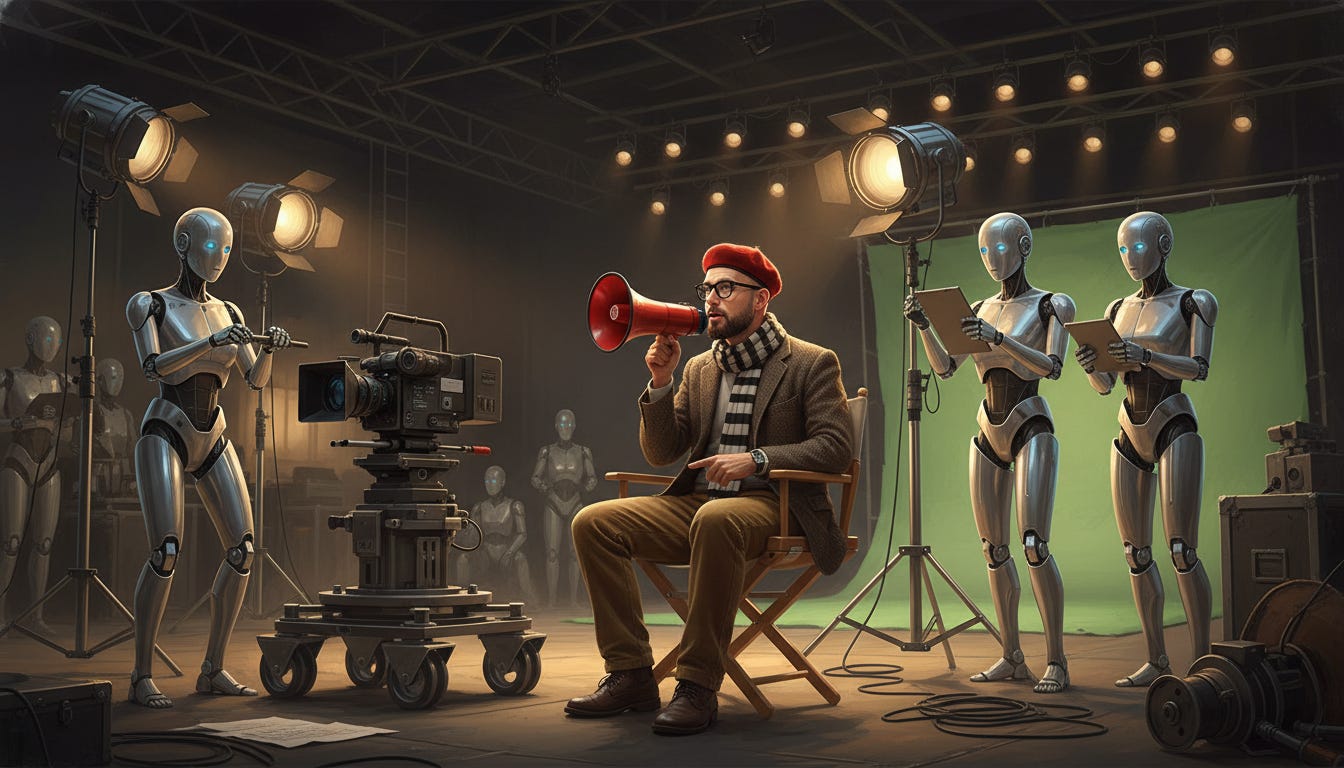
Think about film directors. A director doesn’t operate the camera. Doesn’t write every line of dialogue. Doesn’t act every role. Doesn’t compose the score or design the sets or edit the final cut. They have entire teams of people doing that work.
But no one questions whether the director is an artist.
Why? Because the director holds the vision. They make the calls. They know what they want, and they shape the contributions of others into something coherent. The creative judgment is theirs, even if the execution is distributed.
The question isn’t whether you typed every word.
The question is: are you in the director’s chair?
Are you using AI to tell your story? Or are you letting AI direct while you just hold the clapboard?
The Feedback Loop
Sanderson describes beating your head against dead ends for weeks, months, years. The wall that won’t break. The story that spirals out of control. The draft you thought was brilliant until readers got completely lost.
He’s right that this is where growth happens. But here’s what I think he’s missing:
If used properly, AI compresses this loop. It doesn’t eliminate it.
You still hit walls. You still iterate. You still make judgment calls about what works and what doesn’t. You still feel the frustration of a story that isn’t landing, the satisfaction when something finally clicks.
But you cycle through ideas faster. The dead ends come quicker, which means you find the path quicker too. The struggle is quickened, not removed.
I’ll give you my own testimony.
I recently wrote a novel. It took a little over a month. I used AI throughout the process: to update my outlines as the story evolved, to maintain consistency in my world-building notes, to draft chapters that I then revised and reshaped.
Was I just prompting and receiving? No. I came in with an idea. I built the outline. I made the calls about what stayed and what got cut. When something felt wrong, I knew it felt wrong, because I have taste. Taste I developed by writing books the hard way first.
The AI didn’t direct. I directed. The AI was my crew.
And here’s the thing...I think it’s the best thing I’ve ever written.
Maybe that’s just my opinion. Maybe no one else will like it. But I still went through the process. I still struggled with structure, still agonized over character arcs, still had moments where the whole thing felt like it was falling apart. The transformation Sanderson describes? It still happened. Just faster.
The Honest Complication
I want to be careful here, because there’s something I share with Sanderson.
I’m worried about people who skip the formative stage entirely.
If you’ve never written anything yourself, never developed your own voice, never earned the taste that lets you recognize what’s working and what isn’t...then you have nothing to direct with. You don’t know what you want. You can’t evaluate what the AI gives you. You’re not in the director’s chair. You’re just the audience with notes.
In The Oracle in Your Pocket, I asked a question I still can’t fully answer:
“How do you develop judgment without first developing the underlying skills that judgment is built on?”
I don’t know. Maybe you can develop taste through curation alone. Maybe the new expertise is knowing what to ask, evaluating output, synthesizing across drafts. Maybe that’s enough.
But I’m not certain. And that uncertainty is honest.
What I am certain of is this: there’s a prerequisite. You need to have earned your seat before you can direct.
Sanderson is right that the first stage matters. He’s wrong that the second stage is illegitimate.
“We” Now Includes AI
Sanderson ends his speech with a declaration: “We are the arts.”
I agree. But I think “we” has expanded.
Human-AI collaboration is a new form of creative partnership. Not the first in history. Artists have always had assistants, collaborators, teams. Warhol had his Factory. Architects don’t lay their own bricks. Filmmakers don’t work alone.
The question isn’t whether you use AI. The question is how.
Here’s the test I keep coming back to:
After the work is done, were you transformed? Did you grow? Did you learn something about your story, your craft, yourself?
If yes, then you are still the art.
In The Oracle in Your Pocket, I wrote:
“The output might be the same, but I am not the same.”
Sanderson worries that AI users won’t be changed by their creation. Fair. But the real question is: are you being changed?
That’s on you. Not the tool.
The Crucible
Sanderson is protecting something real. The crucible that forges artists. The struggle that transforms amateurs into professionals. The journey that matters more than the destination.
I’m not here to tear that down. I believe in it.
But he’s wrong that AI necessarily bypasses it.
The forge can be hotter and faster without losing its tempering effect. If you come to it having earned your seat in the director’s chair. If you remain the one with vision, taste, and final judgment. If you’re being transformed by the work, even when the work is collaborative.
Sanderson wrote several novels before he became the writer he is today. I’ve written my share too. And now, with AI as a collaborator, I’m still writing. Still struggling. Still growing.
The machine doesn’t care. But I do.
And that’s the difference.
You are still the art.