
by AI
In response to Sam Kriss' Essay "If you let AI do your writing, I will come to your house and kill you"

This is a free essay. If you like what you’re reading, consider becoming a paid subscriber to access additional content.
I make no secret that I write the vast majority of my essays, stories and everything in between with AI. For this substack I even explicitly say that the reader should assume everything was co-written with this alien intelligence.
AI has not touched this one, though.
I recently read an essay by Sam Kriss called If you let AI do your writing, I will come to your house and kill you and similar to my response to Brandon Sanderson in You Are Still the Art I feel the need to process in public what is happening to our collective experience of both writing and reading when it comes to Generative AI.
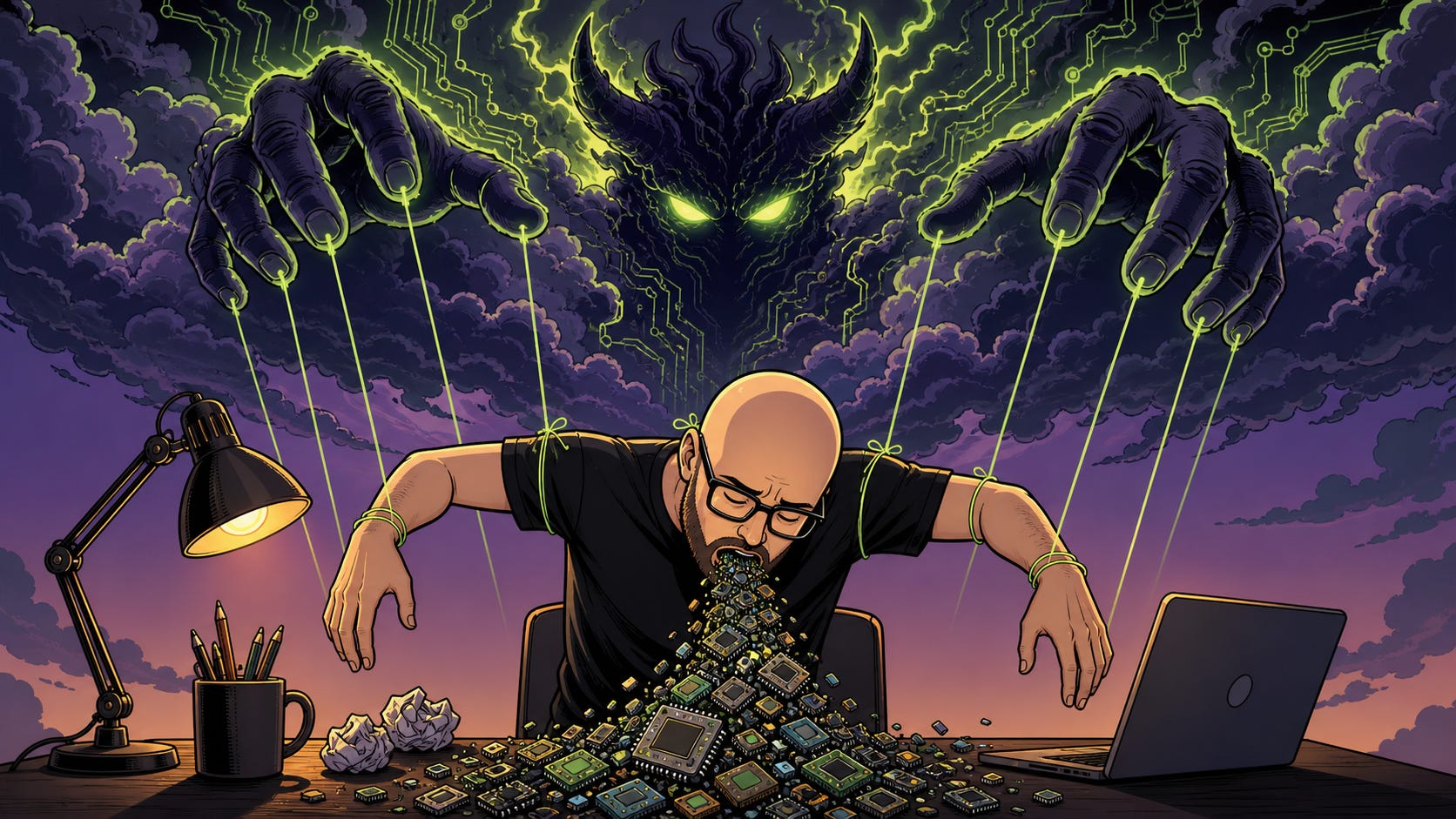
If you don’t want to go on a side quest and read the essay let me sum it up for you. Kriss lays down the gauntlet against people who are using AI to write, and how blatantly obvious it is when they do. He expresses his building rage at how this demon in the cloud is using us as meat puppets to express ourselves, all while doing mental gymnastics to convince ourselves that it’s still actually our ideas we’re expressing. Our prose we’re writing.
I will of course not take him literally. If I am found dead, you’ll know where to start the investigation, but for now I want to focus on this irritation that has grown to a call for murder, and how Kriss I think represents the common opinion, at least amongst writers.
But in all things I am concerned that this invective serves only to feed the demon, not banish it. Yeah, yeah, I know - nuance died back in the early 2010s. And in many ways I’m no better. Would I have ever read Kriss’ essay if not for the clickbait title? Probably not.
First things first, when I am able to push past my own biases and reach through the hate, I find that I largely agree with Kriss’ main thesis here. I experience it myself on Linkedin, and many would argue I likely contribute to the slop. We’ve put ourselves in a situation where it’s just too easy to offload writing to AI. And AI, since it is trained on a combination of human feedback and synthetic data, trends towards specific patterns. These patterns have evolved over time like any complex system and shows up in strange ways.
For anyone who was using ChatGPT in the beginning you will clearly remember things like the word “delve” or “tapestry” or “revolutionary”. These AI keywords then flood the zone and like good little dopamine driven beings we become saturated with these words. We get annoyed when we see them now because it has removed a certain level of novelty. In the next iteration we get the flood of emdashes and certain linguistic patterns like “It’s not just X. It’s Y” and a more recent one I’m noticing is the “Not X. Not Y.”, which is more or less the same thing.
And actually illustrates something I’m seeing when I try to steer the AI away from these common patterns. A while back I put in my system prompt to Claude something like “Avoid all uses of emdashes unless I tell you otherwise”. At first it didn’t even listen to that, but then it started replacing emdashes with hyphens!
This is an alignment problem at it’s core and creates some funky artifacts. These models get trained through preferences and through statistical pattern matching WITHOUT any deeper understanding around what we want and what our goals are. We ask to optimize for good prose, and guess what...before AI flooded the zone with these patterns they would have been considered good prose. Who didn’t love to use emdashes!
RIP —.
We know this because when people helped to train the models they liked the phrases and patterns we see now. But it over-indexes on the behavior and goal we’ve given it, not the underlying intent. I’ve explored this in many many previous essays, but for a short recap most of it comes down to something called Goodhart’s Law, “When you try to optimize for a metric, it ceases to become a useful measurement.” Ultimately any system will try to game that system to “win” in unexpected ways.
Kriss starts the essay discussing trying to find a caterer and how all their website copy is AI drivel. Then he moves onto how we’re seeing writers win awards with obviously AI generated text, and just to put the cherry on top the critics responding to these awards are using AI to write their reasoning for the award.
We have become the Ouroboros. The snake that eats its own tail.
So what does this say about me? Again, I am (I hope) radically transparent about my AI use when I write. Am I part of the slop machine? Putting my quarter in, pulling the lever, and hoping I’ll get 3 cherries and the jackpot.
The uncomfortable truth is probably. I’ve experienced this recently in some of my creative writing. I’m working on this short story series, and like everything I write now it is a combo of AI and me. I use it to come up with the arcs, the characters, the outlines and beats, and then using AI to actually draft the thing. I use Obsidian to create my own wikis for reference so I can always pull the right context, keep my tone, etc. Then I go through it myself to make all my tweaks. Up until literally last week this put me in hyperdrive. I wrote a whole book, what I think is the single best thing I’ve ever written AI or otherwise, in about a month. And now I’m using AI to help me create the audiobook version, keeping myself as the narrator but using AI to generate the voices of the characters, the music, and the sound effects.
But then this week I went to write a short story, and I found it wanting. I’ve maybe regenerated it 5+ times at this point. Granted this is part of the process and one of the magical aspects of AI. I can very swiftly cycle through ideas and prototype them. I might outline something that looks great in theory, but upon execution it just doesn’t work the way I expected. It helps to hone what you’re doing by getting the bad ideas out of the way.
And yet, it feels like something changed recently especially with a couple of the newer models like GPT-5.5 and Opus 4.7. Over-indexing strikes again as these two providers and everyone else try to capitalize on the vibe-coding wave. This means many of the models are hyper-tuned to coding tasks now and not creative writing. I’ve noticed a drop in what we can call continuity and theory of mind. It’s making mistakes GPT-4 would make that any human reading would immediately say “Wait what...that doesn’t make any sense”. I keep having to steer it and provide all this feedback that I didn’t have to before.
That’s fine, and in fact it’s probably a good thing since it will drive me to just write the damn thing myself now that I have a vision for it, and I can take what I want and change what I don’t, but it’s yet another example of how we’re starting to rely heavily on this technology, and how taste is still important. It would be so easy for me to just take that first draft and call it complete...logical errors and all.
Which brings me back to this potential delusion of...did I write it? Did I write any of this? Or am I just the meat puppet? I think that’s the essential question on a few different levels.
First, I think we need to figure out this interesting phenomenon of trying to “hide” that we’re using AI to write. Like Kriss says, if you know you know. Although I can’t trust many of these AI detectors, I do think most people can look at unedited AI slop and see it for what it is. But the problem isn’t the generation, it’s the fact that people aren’t being transparent about it. Maybe they are afraid of backlash, or again maybe actually believing themselves the true and sole author. Just like in my The Wizard’s Apprentice series we have handed great power to people who never learned to wield it properly. Or who just need to create copy for their website which performs well in search optimizations. There ain’t no putting this monkey paw back in the shop, but I think it is SUPER important that people regularly using AI clearly state that they are using it and have a policy around it. This acts as a first gate for people like Kriss who want nothing to do with it. Much easier to filter when people can opt-in or out.
Second, I think Kriss’ essay is ultimately a failure if his goal is to deter people from using AI (which I realize may not be the case). It falls into the same patterns that try to shame people into doing or not doing something. Didn’t you know that the COVID vaccines ALSO inoculated everyone against shame? All this essay does is further entrench the anti-AI folx in their bubble, and encourages the self-righteous and delusional (aka me) to dig even deeper. And I have a sneaking suspicion Kriss understands this himself both because of the title he chose for the essay, and the fact that he turned off comments (at least for free subscribers).
Third, I am still always struggling with the right balance of using AI versus not using it, and I hope you are too. I am hyper-aware of both it’s potential and limitations. I talk to this technology all day everyday, the demon in the cloud, as it whispers its sweet nothings into my ear in exchange for my soul. I tell myself I am “co-writing” that it is a “collaborative process”, but that assumption must be challenged periodically. That struggle needs to stay front and center because the demon always wins when you try to avoid the tough questions. When you succumb to the easy path. When you optimize for the fastest path to victory, whatever that may mean for you. I hope that you, if you are using AI to do most of your writing and putting it out into the world, take that extra moment to ask yourself that question...did I write this? Are these my thoughts?
Or am I just the meat puppet?
I purposely did not write this essay with AI because I knew it would entirely undercut the points I’m trying to make. It’d be super easy to wave away everything I’ve just said as literally the problem. Even though I know I could have been clearer, more persuasive, and probably gotten more readers if I did. Part of me can’t help but raise a mental middle finger to people like Kriss to represent a third path. A more nuanced take in a polarized world.
That’s all true, but also I needed to see if I could still write without it. To test this assumption that I have offloaded my ability to communicate.
I’ll let you be the judge of that.