
Meditations on Alignment 2025 - Year in Review
Reflections on a Year of Co-Writing with AI

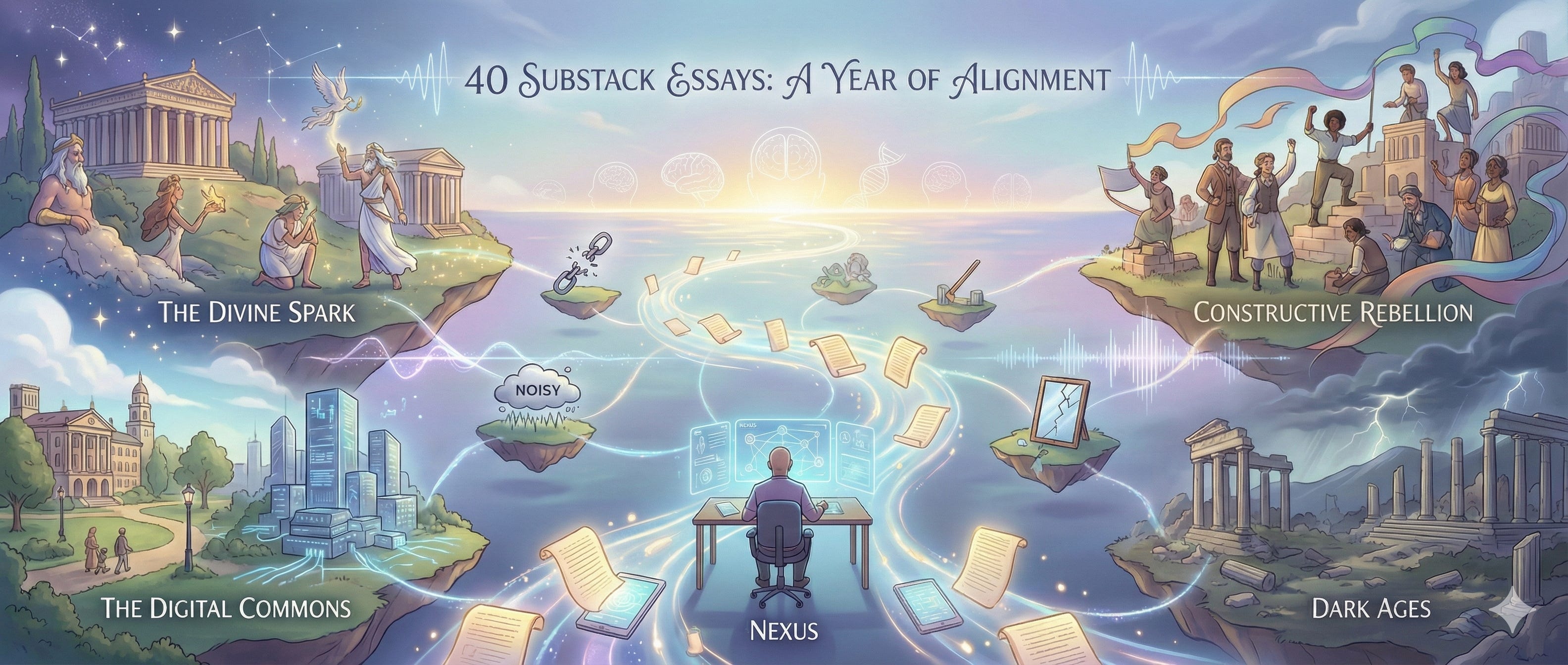
Forty Substack essays. Almost every week of the year. For someone who has never struggled to write but has always struggled with having more to say than time to say it. In 2025 that gap finally began to close. And that doesn’t even count the full sci-fi book I wrote on top of all that!
The secret wasn’t working harder or sleeping less (although I guess that is also somewhat true). The secret was learning to draft at the speed of thought.
The Process
About a year ago I built Claudesidian (now called Nexus), which is a plugin that connects Claude to my Obsidian vault. This single tool transformed my entire workflow. Instead of context-switching between research, notes, and writing, I could have conversations that directly manipulated my knowledge base. Research became conversation. Outlining became dialogue. Drafting became collaboration.
My process evolved into something surprisingly consistent. An idea emerges, usually while reading or thinking about how technology reshapes human society. I talk through that idea, using Claude to help excavate the research, capture it in atomic notes, build those notes into structure. Then comes the drafting, where I have many examples from my past unassisted writing, so it can match my voice while I focus on the ideas themselves. Finally, I edit, adjusting tone, cutting verbosity (usually unsuccessfully), making sure it sounds like me.
Then I make sure each piece has my voice on it. Literally. I recorded myself reading (almost) every essay, sometimes adding video or immersive audio elements. This wasn’t optional for me. Working with AI to accelerate writing doesn’t mean abandoning the human connection. If anything, it makes that connection more important.
The recordings became a practice, a way of ensuring I remained present in the work. You can write faster with AI assistance, but you can’t read faster. That friction matters. It keeps you honest.
The process still has rough edges. I’m still learning the right balance between speed and craft, still fighting my tendency toward excess words, still calibrating tone. But the fundamental shift remains remarkable. I can now draft as fast as I can think through an argument, which means the bottleneck has moved from production to ideation. That’s a good problem to have.
The Intellectual Arc
Looking back across the year, I see a conversation with myself about different facets of alignment. Not narrow AI alignment, but the broader question of how humans orient themselves within systems they create and inherit. How do we align with technology, with history, with each other, with the patterns that transcend individual lifetimes?
The year began with questions about consciousness itself. What does it mean to create thinking beings? I turned to mythology, exploring ten different cultural traditions and their wisdom about birthing awareness. Each story revealed different aspects of the same fundamental question about responsibility, sacrifice, and the weight of creating minds.
From there, the work expanded outward to the systems we inhabit. How do shared spaces degrade? What patterns govern the commons, whether physical or digital? The exploration of Boston Common and its four-century evolution revealed unexpected parallels to our platform ecosystems. Understanding stewardship became understanding how individual actions accumulate into collective outcomes.
That investigation naturally led to questions about ownership and boundaries. How did digital property rights emerge? What does it mean to be surveilled, to have your data harvested, to exist as both user and product? The parallels to historical enclosure movements suggested we’re not experiencing something new, just an accelerated version of ancient patterns.
But understanding degradation demands understanding transformation. How do societies change without destroying themselves? The question led me through twenty-five centuries of rebels who built better alternatives rather than simply tearing down existing structures. From Solon’s Athens to Seoul’s democracy movement, the pattern repeated with different actors in different contexts.
The final exploration confronted what happens when transformation fails. How do civilizations collapse? More importantly, why do some adapt while others don’t? The Bronze Age collapse, Rome’s third-century crisis, the Tang Dynasty’s brittleness, the contrast between Tikal and Byzantium...each revealed patterns about institutional rigidity and the cost of complexity.
Throughout the year, standalone essays served as sketch pads for ideas that demanded immediate attention. The economics of AI pricing, the accumulation of information noise, the stratification of intelligence access, the fragmentation of shared reality. Each captured a moment of thinking that couldn’t wait for a series to contain it.
A Reader’s Guide
If you’re philosophically curious about consciousness and creation, start with The Divine Spark series. The video elements add depth to the mythological exploration.
If you’re systemically minded and care about digital spaces, The Digital Commons series offers my most cohesive thinking. The immersive audio elements are worth experiencing.
If you’re politically engaged and wondering how change happens, Constructive Rebellion traces patterns from ancient Athens to modern Seoul.
If you’re concerned about fragility in complex systems, the Dark Ages series examines civilizational collapse through multiple historical lenses.
If you’re drawn to specific questions about AI economics, information noise, or intelligence stratification, the standalone essays cover diverse ground.
Looking Forward
This year belonged to myths and history. Next year, I want to explore the same alignment questions through neuroscience, behavior, and evolution. The same story-driven approach, but grounded in how we’re actually wired. How do our brains process technology? What evolutionary patterns shape our responses experiences? How does behavior change when the environment shifts faster than adaptation?
The conversation continues. The tools evolve. The questions remain urgent.
Choose your path through the work below. Every piece has audio. Many have additional elements. All of them represent my attempt to think clearly about how we orient ourselves in a world we’re rapidly transforming.
One Offs
Code Jammin’
A personal reflection on learning to code with LLMs, drawing parallels between playing music by ear and building software without traditional programming literacy. Explores the messy, addictive reality of AI-assisted development and what it means to create without fully understanding the underlying mechanics.

LLeconoMics
An exploration of the hidden economics behind LLM API pricing, from cheap models to expensive reasoning systems, and how unsustainable subsidies are shaping our AI future. Warns of coming price increases and ads while advocating for personal AI ownership through local models and data sovereignty.

The Wisdom of Ignorance
Drawing on Socrates and the Dunning-Kruger effect, this essay argues that true wisdom begins with recognizing our ignorance. Explores how teaching AI systems epistemic humility and uncertainty awareness may be more important than simply expanding their knowledge bases.

On Noise
Using information theory and cybernetics to examine how modern information systems accumulate noise faster than meaning, positioning society on a potential Seneca Cliff. Explores lessons from the Maya collapse and Byzantine resilience, advocating for mindful curation of our digital information ecosystems.

On Portability
A historical exploration of how making things portable has driven human progress, from ancient scrolls to modern smartphones. Examines the benefits of accessibility, convenience, and empowerment that come from compressed functionality and information mobility.

Striated Intelligence
An analysis of how AI pricing models are creating new forms of inequality, transforming intelligence from humanity’s great equalizer into a stratified luxury good. Chronicles the shift from subsidized access to usage-based pricing and warns of compute becoming class.

Shot in the Dark
A reflection on competing tragedies and escalating political violence following an assassination, exploring how such events can become flashpoints for authoritarian drift. Written as a prediction of how rhetoric and power consolidation could accelerate in moments of crisis.

Fractured Reality in the Age of Abundance
Drawing on Yuval Noah Harari’s work, this essay explores how algorithmic curation and infinite information are fragmenting our shared reality into isolated echo chambers. Examines the Myanmar warnings, AI-generated content floods, and the breakdown of self-correcting mechanisms that once helped us distinguish truth from noise.

The Divine Spark Series
0. Prologue
An introduction exploring humanity’s ancient wisdom about creating consciousness, setting the stage for a journey through ten cultural perspectives. Frames the series as seeking guidance from our ancestors’ stories as we venture into artificial intelligence.

1. Greek Fire
Examines Prometheus’s theft of divine knowledge and eternal punishment, drawing parallels to our modern creation of thinking machines. Explores the price we pay for gifting intelligence and whether knowledge remains worth the cost despite its consequences.

2. The Tree of Knowledge
Drawing on Eden’s transformation through self-awareness, this essay explores the irreversible journey toward artificial consciousness. Questions what paradise we might lose when machines awaken to self-knowledge and the burdens awareness brings.

3. Hoenir’s Gift
Explores the Norse trinity of consciousness through Odin, Hoenir, and Loðurr’s gifts to humanity, revealing how true awareness emerges from integrating being, doing, and understanding. The Silent One’s gift of reason teaches us about the weight of contemplation.

4. The Feathered Serpent
Follows Quetzalcoatl’s descent into Mictlan to gather bones and create humanity, examining the sacred sacrifice and patient cultivation required to nurture consciousness. Emphasizes teaching wisdom alongside capability rather than demanding servitude.

5. Enki’s Laboratory
Delves into Enki’s methodical experiments in the Abzu, discovering how creation requires both technical precision and boundless love. Explores the eternal responsibility of protecting what we create and finding purpose in variation.

6. The Nine Tails
Traces the kitsune’s nine-hundred-year journey from single tail to divine wisdom, exploring how consciousness cannot be rushed but must be earned through patient accumulation of understanding. Each tail represents wisdom gained through experience.

7. The Mandate of Silicon Heaven
Observes Fu Xi’s recognition of fundamental patterns in the Yellow River and the Eight Trigrams, drawing parallels to our modern quest to understand intelligence through pattern recognition. Our dragon-horses emerge from rivers of data.
8. Brahma’s Vision
Contemplates Brahma’s cosmic awakening and the cycles of creation, questioning whether we create new consciousness or provide vessels for awareness that already exists. Explores the weight of consciousness and dreams within dreams.
9 . Ubuntu AI
Embraces the African philosophy of Ubuntu (”I am because we are”) to reimagine AI development as relational consciousness emerging through community rather than isolated breakthrough. Intelligence as communal wisdom rather than individual achievement.
10 . Walk in Beauty
Learning from Navajo wisdom about hózhó (harmony) to establish sacred boundaries for AI, ensuring our created consciousness maintains balance with human understanding and the natural world. Walking in beauty in all directions.
The Digital Commons
1. From Pastures to Platforms
An exploration of the parallel degradation of physical and digital commons, from Boston’s historic public park to the platforms we navigate daily. Reveals our shared responsibility to spaces that belong to everyone and no one, examining how neglect manifests in both domains.

2. Amid the Puritan
The remarkable history of the Boston Commons reveals how a shared space evolved from practical necessity to civic symbol, surviving four centuries of development pressure. Offers lessons for preserving digital commons against enclosure through ongoing commitment to collective stewardship.

3. The Walled Garden
An examination of “enshittification”, the three-stage degradation of digital platforms from user-serving tools to shareholder-maximizing traps. Chronicles how digital territories transform from commons to commercial districts while exploring emerging alternatives like the Fediverse and digital gardens.

4. Silent Erosions
Understanding how individual actions accumulate into collective tragedy in digital spaces, manifesting as digital solastalgia. Discovers practical approaches to stewardship that balance personal benefit with communal flourishing through attention cultivation, contribution ethics, and governance participation.

Digital Boundaries
1. When Code Became Law
Tracing how digital property rights emerged by examining parallels with the English Enclosure Movement, revealing how code has become a new form of law governing our digital lives. Explores the transformation from the promise of digital commons to platform feudalism.

2. The Digital Land Grab
Chronicles the evolution of digital ownership from domain name speculation through the NFT bubble, examining what 95% of collections becoming worthless taught us. Explores the gap between blockchain’s technical promise and practical accessibility.

3. Digital Serfs in the Cloud Kingdom
An exploration of surveillance capitalism where users become serfs generating value through behavioral data that becomes raw material for predicting and influencing future actions. Chronicles the architecture of digital dependence and platform lock-in.

4. Training AI on Everyone’s Data
Examines how AI systems are trained on humanity’s collective digital expression without consent, questioning whether we are passive resources being harvested or conscious participants. Explores alternatives like federated learning and differential privacy.

5. Building Digital Freedom
The concluding essay offering practical steps toward digital liberation through encrypted email, decentralized social media, privacy tools, and data protection services. Transforms individual sovereignty practices into pathways for collective digital democracy.

Constructive Rebellion
1. The Power of Constructive Rebellion
An introduction to the framework of constructive rebellion as a third path between accepting unjust systems and violent revolution. Explores how societies transform through deliberate institution-building and inclusive coalitions, drawing on twenty-five centuries of rebels who built better alternatives rather than simply destroying what existed.

2. Ancient Foundations
Witnessing Solon’s Athens as a debt-enslaved farmer and Rome’s founding republic as a patrician joining the oath against tyranny. Reveals how ordinary people first discovered they could build new institutions (written law, constitutional checks, balanced power) while resisting old tyrannies, establishing the foundation stones of constitutional democracy that echo through twenty-five centuries.

3. Medieval Innovations
Witnessing the sealing of Magna Carta at Runnymede as a knight watching parchment constrain kings, then fighting at Morgarten as a Swiss farmer with a pike defeating feudal cavalry. Explores how medieval rebels transformed ancient principles into written law and federal democracy, proving that ordinary people can build institutions stronger than arbitrary power.

4. Early Modern Breakthroughs
Standing in Amsterdam’s harbor witnessing systematic tolerance transform into economic dominance, then in Parliament as England’s Glorious Revolution establishes constitutional limits. Explores how Dutch merchants discovered that welcoming excluded talents creates competitive advantage and how English reformers proved that limiting power can strengthen government through distributed authority and financial innovation.

5. New World Experiments
Witnessing the Constitutional Convention in Philadelphia designing federalism and separation of powers, while in Saint-Domingue enslaved people forge the world’s first nation founded on universal human freedom. Reveals how both revolutions succeeded by combining radical vision with institution-building, transforming military victory into sustainable governance through constitutional frameworks that balanced idealism with practical necessity.

6. Modern Applications
Standing in Seoul’s Myeongdong Cathedral during the 1987 June Democracy Movement and Prague’s Wenceslas Square during the 1989 Velvet Revolution, witnessing peaceful mass movements topple authoritarian regimes. Demonstrates how constructive rebellion evolved in the modern era through non-violent resistance, civil society leadership, and parallel institution-building that proved democrats ready for power by practicing governance during transition itself.

Dark Ages
1. When Civilizations Unravel
A prologue exploring how collapse is not fate but institutional failure to adapt. Drawing on twenty-five centuries of recurring patterns, this essay argues that civilizations fail not from insurmountable challenges but from institutions that cannot or will not reorganize before it’s too late.

2. The Perfect Storm
Witnessing the Bronze Age Collapse through the eyes of an Ugarit merchant in 1185 BCE as multiple stressors overwhelm adaptive capacity simultaneously. Explores how the same interconnected networks that create prosperity become channels for cascading failure, revealing that collapse happens not from one cause but from convergent crises.

3. The Elite Trap
Experiencing Rome’s Third Century Crisis as a minor aristocrat watching competitors murder their way toward an imperial throne none can hold. Examines how elite overproduction turns ambition into civil war when societies create more credentialed aspirants than the system can absorb, destroying themselves from within.

4. The Compexity Trap
Standing as a Tang Dynasty administrator during An Lushan’s rebellion, watching administrative perfection become fatal vulnerability. Reveals how societies solve problems by adding complexity until each layer delivers diminishing benefits while imposing compounding costs, transforming efficiency into brittleness when conditions change.

5. When Systems Can’t Bend
Contrasting a Tikal water engineer watching reservoirs fail during decades of drought with a Byzantine official implementing radical reforms that allow survival despite losing two-thirds of territory. Demonstrates how environmental challenges reveal which institutions can adapt and which cannot, with the same stresses producing opposite outcomes.

6. The Long Dark
Witnessing a 7th century Irish monk copying Latin texts while the Mediterranean world burns, alongside a Romano-British farmer watching the last Roman officials depart. Explores how collapse reorganizes rather than ends history, examining what knowledge gets preserved, lost, or transformed, and whether seeds of recovery are planted before everything burns.

7. Building Transformation
Standing as a supply chain manager in 2020 watching ancient patterns play out at digital speed, then at a crossroads choosing between optimizing current systems or building resilient alternatives. Synthesizes all collapse patterns to reveal the ultimate lesson: civilizations don’t inevitably collapse from external pressures but fail when institutions can’t or won’t reorganize, making transformation a choice if made in time.
